Monday, 14 July 2014

Gearing Up 2.0: Decking

The post I wrote last year on the various geeky gear I had procured was one of the most popular on this blog (which, admittedly, isn't a high bar to leap). Having just done much the same thing (a.k.a. 'ridiculously overloading') for my desk as for my bag, I though I'd give the rundown on my setup here.

The Desk
When I first got my own furniture, the desk was by far the most important thing (with the accompanying chair a close second). I spend a big chunk of my time (arguably too much) in that space, so it made sense to get it right.

The IKEA Malm desk was a solid choice. Quite literally - it's thick and sturdy, as well as providing a great amount of space, with a 'shrinkable' footprint, useful if required to move it to a smaller space, thanks to the sliding side section. Since I lived first in a studio flat, it was almost the only non-kitchen surface, meaning it was hugely overcrowded with stuff. That is now very much fixed, and three years on, it's pretty much the best desk I could wish for (sapient pearwood notwithstanding).
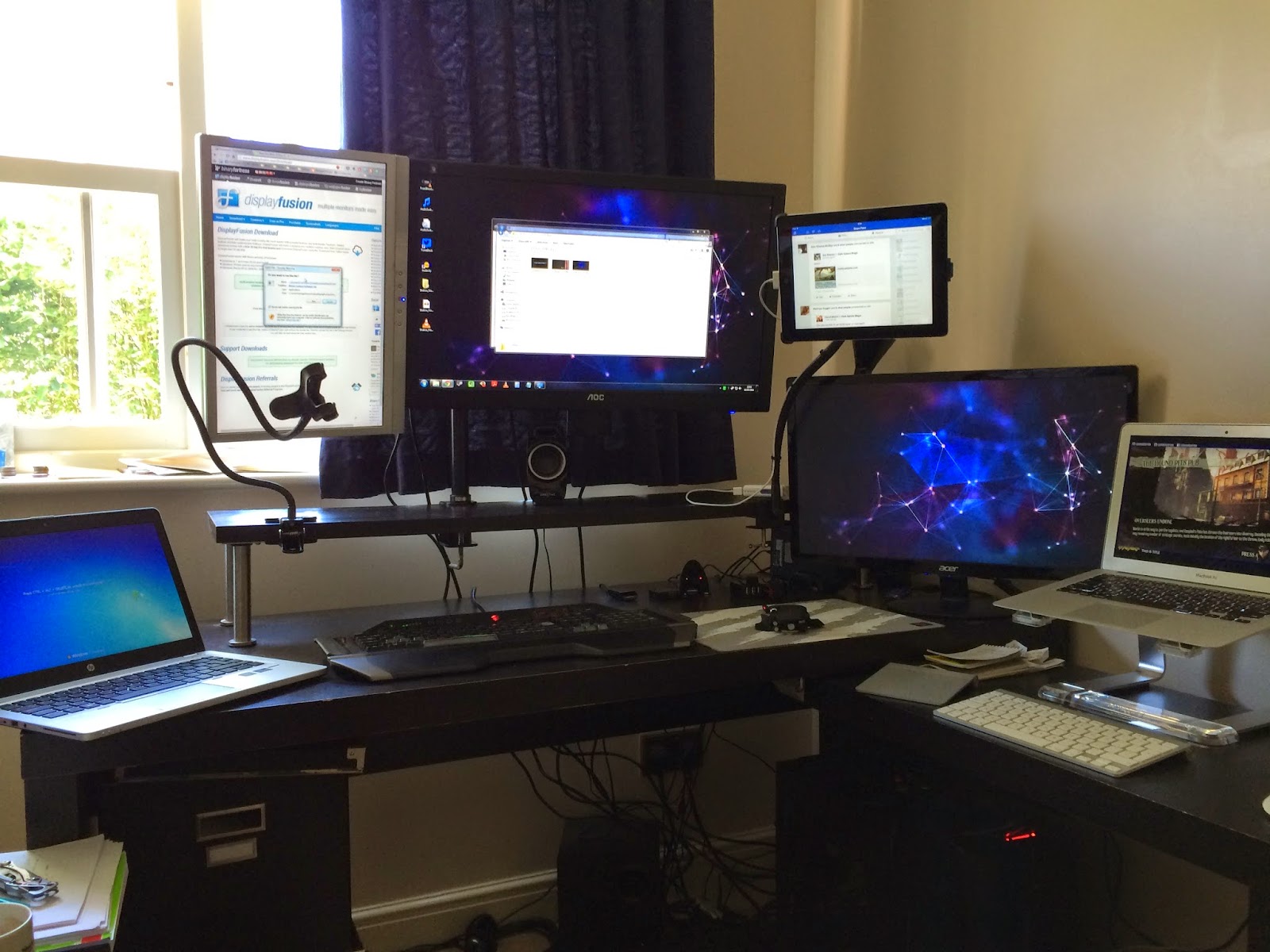
The full ensemble, complete with added work laptop


The Shelf
'The what?' you say. 'How important is a shelf?'. Well, let me tell you now - adding a raised unit was just about the best 'upgrade' I made to the desk. If you have one or more external monitors, the ability to raise them up clears a surprising amount of room. You can slide keyboards and other stuff under it, giving yourself more space for papers and hand writing as needed. It also enabled some neat stuff that I'm about to mention.


The Laptop Raiser
This is one of those things that definitely fits in the 'not necessary, but surprisingly useful' category. I use a combination of my desktop PC and my MacBook Air (as well as another laptop when working from home). Up to now, I have mixed and matched how I set these up with my external monitors, but the laptop generally sits on the side unit.


Adding a good laptop raiser - the Griffin Elevator raiser - has brought the screen and keyboard to a better height, such that I can turn to it and use it comfortably without having to shoot down on my chair.

There are ancillary benefits, such as better cooling, but these generally don't really factor in 95% of the time.

The Screens
Now we get to the fun stuff. Anyone who knows me may well think I have somewhat of a screen addiction. I'm not going to dispute that, but a good screen setup goes a long way if you're using a computer for any length of time.


I installed a clampstand with articulated arms for my main screen, fixing it to the shelf (as this is where the Malm desk's thickness works against it - you can't clamp things onto the main surface). Annoyingly, my secondary screen turned out not to be mountable, but this has actually worked out better than I thought. I've strapped up my smaller, 19" monitor vertically. This works well as a Twitter feed, Evernote screen, A4 PDF viewer, or even just for showing general widgets. Both it and the main screen are easy to rotate, adjust and move as required. My secondary, 24" screen sits nearer to the laptop stand.

While I'd love to stick more screens in here and have the full three running off each machine, the (probably better) compromise I've come up with is adding an HDMI switcher to the main monitor. This means I can quickly switch whether the macbook or the PC displays there. The PC is my main gaming machine, but I use the Macbook more for writing, so that flexibility is really useful.


Tablet and Phone Clamps
To round it out, we have what's probably my favourite part. If you use a tablet with any frequency, I strongly suggest checking out one of these clamp stands. There will almost certainly be somewhere you could benefit from it, be it at your desk, in the kitchen, even on your bed.


The tablet clips in easily and can be held in just about any position by the gooseneck, while still being easily adjustable and rotatable. Having your tablet just there in front of your face is surprisingly useful. I use it to display my calendar, check social media, email or messages, or just for quickly looking up things while in game. Its default position isn't great for typing on it, but it's easy to adjust or work with voice commands.

The same applies for the phone - it's good as a hands free from taking calls, or just as a FaceTime/Skype camera.


Added bonus - if you take out the tablet and use a bulldog clip, you can hang printed documents from the tablet stand.

The fact that I'm writing this at all probably shows you how obsessive I can be about this sort of thing, but seriously, this feels like a great setup. Not everyone has the space or even the want/need (I'm not sure that I have the need, really) for this sort of setup, but even little things like raised units and tablet stands can make a great deal of difference.

The overall effect is to give a functional yet flexible workspace, where you have access to a good amount of screen real estate (usefully positioned), but still have plenty of workspace to put things (books, reference material, whatever’s your jam (don’t put jam on your desk)) or handwrite or whatever. Proper monitor stands, clamped goosenecks (honk) and raised units can go a long way to ‘creating’ additional space, regardless of what you started with.


As ever, you can question/vent/share thoughts in the comments, and find me on Twitter @mastergeorge.

Wednesday, 9 July 2014

Short Story: Breadcrumbs

This is more of a bit of flash fiction than a short story, only running to around 1,100 words. It comes with a minor content warning, which is why I haven't dropped it in straight here as a post.

It's about a person who can't stop finding bodies...

Click here to read Breadcrumbs.

If you struggle with the white-on-black text of the blog, or just want to read it offline more easily, you can grab a PDF version here.

Monday, 7 July 2014

Twilight Imperium: First Impressions

I finally got the chance to play Twilight Imperium recently, and wanted to share my experience. It really  is the behemoth of board games, and it requires a significant time investment if you ever get the chance to play it, so it's worth knowing what to expect.

That said, I don't think its fair to couch this as a review in the way I did with Pandemic and The Game of Thrones board game, since I have only played it once. So, instead, here are my first impressions of Twilight Imperium (TI). 

Space: it's full of plastic
Firstly and most obviously is the scale and scope. The game has you vying for control of the galaxy following the fall of the tyrannical Lazax empire. While TI has much in common with Risk as a game of strategy warfare, it is so much more than that. You don't just have to consider the military arena, but also the economic, political and technological.

It's not only possible to survive while being militarily weaker than your opponents, but also to thrive, as you lean on your other advantages to gain leverage on the other players. I took on the role of a race that was, broadly speaking, the 'military-industrial complex' - the Barony of Letnev - while the player to my right was a race of more pragmatic, trading-focussed space lions - the Emirates of Hacan.

While I started in a position from which I could threaten and bluster my way into profitable trade agreements - to ensure 'mutual coexistence' given our proximity (read: not turning my fleet into a giant space vacuum cleaner and blasting the kitties into the nearest supernova) - his economic superiority, combined with some of my own poor fortune (read: poor planning), meant that I became pretty dependent on that relationship to maintain any grip on power by the middle of the game. Since my race needed trade goods to gain an advantage in combat, the cancellation of that trade agreement would have been pretty disastrous. I found myself Harkonnens, beholden to my very own Guild.

My fleets about to get into trouble with the dreadnoughts from my left
The fact that such a dynamic relationship is actually possible in the game speaks volumes of what TI is all about. But that also comes with its downsides. It took me around two hours just to clip out and bag all the pieces that came in the box. Setup and explaining the rules took around 30 minutes each - and this was with a group who had familiarised themselves with the principles ahead of time.

For all that there are a lot of rules and pieces to get your head around, the complexity of each part isn't so bad. Pretty much every piece of the puzzle makes sense in isolation, it's the just the whole picture taken together can spin the brain faster than one of my cruisers going down in flames.

Even once we had gone through all of the rules, it still took some hands-on figuring out before we really got to grips with the flow of the game, and I think it was actually pretty near the end before we got a good handle on how it 'should' be played. The game makes many different strategies viable, depending on the race you're playing, but it takes some familiarity to figure them out. As it was, being our first playthrough, we lacked the context to make defensibly sound decisions, but at least everyone was on the same level coming into it.

That's both a good and a bad thing. On the one hand, it rewards repeat play, offering a depth that allows you to experiment and find your stride, getting 'better' over time, which is generally very satisfying. Additionally, if one strategy bores you, there are plenty of alternatives available (play a political or trading race!). The flip side is that, given an average eight-hour duration, getting to play it with any frequency becomes a challenge.

There are also some well-known and well-justified balance issues. Generally, everything is pretty finely designed to avoid weighting advantage to any one player early on. However, one of the Strategy Cards (each player selects one Strategy Card per turn which defines their special action) is a fast and reliable means of scoring victory points - the whole goal of the game - meaning that it becomes 'technically correct', in terms of optimal gameplay, to select this card whenever you are able, regardless of the other choices. If the card is not available, your second choice should always be the 'Initiative' card, which sets you up to take it next turn.

As long as players are aware of this, it's not 'game breaking', but it does suck some of the fun out if you feel compelled to take it all the time, rather than trying to plot and execute a wider strategy. We were aware of this, but still didn't do enough to prevent it throughout the game. The expansions contain some alternative versions of this card which 'fix' the issue, but it's quite a frustrating limitation of the core game, and I'd recommend house-ruling it if that's all you're playing with.

At least the expansion has a normal-sized box
Twilight Imperium is a very deep game with more replay value than I've seen anywhere else. There are so many optional additions and other play styles enabled in both the core game and the expansions that you could play this game over and over without it getting stale. The playtime and dense-if-not-actually-high barrier to entry are marks against it, but, as long as everyone is on board with this from the start, it's actually fine. Just don't let it take you unawares. 

The group that I played with was overwhelmingly enthusiastic about how TI played out and the epic drama it let us build, and seemed interested in picking it up again if there was the chance (unless they were just trying to justify investing eight hours of their time...!). 

So, should you play TI, or even buy it? If you're a fan of 'big box' boardgames in general, it's hard to see you not liking this, since it's a big strategy game on steroids, so give it a go if you ever have the chance. That said, it is a reasonable investment to buy, not to mention store, so I'd say skip purchasing it unless you know and love the game already, or you have a guaranteed audience of (almost) equally enthusiastic people to play with.

Pax Magnifica Bellum Gloriosum

Friday, 4 July 2014

The Hap This Week - 4th July

In the spirit of last week’s short collection of interesting (and old links) from across the ‘net, I thought I’d stick in a few more topical and relevant ones this week.

Posts This Week:
The Long Haul - my review of Terry Pratchett and Stephen Baxter's The Long Mars
Top 5 Tabletop Games to Play in the Pub

Stupid Decision Overturned in 'Sanity Prevails' Shocker
I don’t really follow Hearthstone or the associated community, and thankfully missed the first outcry about this when the news broke that an upcoming Hearthstone qualifier tournament would be gender segregated. The article sums this up far better than I can, as well as why it’s just a plain dumb idea, but some credit should be given for actually listening and changing the decision, as well as keeping ‘woman only’ brackets an option. You can debate the ‘equality’ issue in terms of men-only vs women-only, but it’s not just about complete parity - it’s about ‘redressing the balance’ and trying to fix an existing problem, namely, the underrepresentation of women.
Esports Org Divides Men & Women, Changes After Outcry - Rock Paper Shotgun


Firaxis Announces Release Date for Alpha Centauri Successor, George’s Time Management Weeps
I always forget just how highly Firaxis rates in my hierarchy of awesome game makers. Their most recent giant time suck for me was XCOM: Enemy Unknown (and Enemy Within). A truly phenomenal game which I just can’t tear myself away from. Sid Meier’s Alpha Centauri (essentially Civilization in space) was one of my all time favourite strategy games, and a successor to this, if done right, should be a blast.
Civilization: Beyond Earth enters orbit on October 24 - Joystiq


I finally got the chance to play Twilight Imperium on Sunday, and am going to share my first hands on impressions soon. I’ll leave you with the old but interesting ‘History of Social Games Flowchart’, showing the development of gaming from the ancient world to today (well, more or less). Original source: http://radoff.com/blog/wp-content/uploads/2010/05/HistorySocialGames1.jpg


Wednesday, 2 July 2014

Top 5 Tabletop Games to Play in the Pub

One of the hardest things about games is finding the time to get everyone together in one place. This is particularly difficult if you need to assemble everyone in someone's house or flat - apart from being a pain in the proverbial, travel also eats into valuable gaming time or makes the whole affair untenable.

So great indeed is the game that you can play in the pub (or equivalent dispensary of jollity) with your friends. Sadly, there aren't that many establishments where you can get away with whipping out large box and battling for supremacy over Westeros - if nothing else, the giant throne tends to attract attention. That said, if you're based in London, check out the nascent 'Drafts', or any of other UK board game cafés, such as The Thirsty Meeple in Oxford, etc. In a regular pub, though, it's all about finding the right game.

Here are some of my favourites. Criteria for success are having a small footprint (no big boards or the like, which is why you won't see Forbidden Island on here, despite it being both portable and amazing), compact and portable, and as simple and light-hearted as possible, while still remaining interesting.

So here they are, in no particular order.

Fluxx


Fluxx is almost as simple as they come. Every turn, draw a card, play a card. At first, that is. The catch is that some of the cards change the rules as you go along, meaning it might become something different, like 'draw four cards, play three' every turn.

It comes in all sorts of flavours, such as 'Star Fluxx', 'Zombie Fluxx' and 'Chthulu Fluxx' (because what tabletop game can't be improved by adding 'space', 'zombies' or 'fhtagn'?).
Just look at him - doesn't he just scream fun?
It's not exactly what I'd call 'strategic', though, since the extremely high randomness and variance make strategic execution somewhat ...tricky. Normally, that's precisely what I dislike about Fluxx - it's essentially 'prescriptive', lacking many meaningful excision points - but in the pub, where people are already impairing their ability to follow an ever-changing set of rules, it seems more fun.

Play if: you want your game to move as erratically-but-amusingly as that man trying to find his way back to the bar.


Zombie Dice


Another pretty obvious inclusion here. I seem to include it just about every one of my lists. It's simple, it's easy, it comes in a cup, and none of the important components are made any the worse by acquiring beer stains. What more do you want?

Seriously, if you want to know more about it, check out my previous post.

Play if: all this talk of brain-eating isn't going to make you too hungry for a tasty and totally non-suspicious kebab.


Cards Against Humanity


Oh boy, what's left to say about this one? To call CAH 'foul mouthed' would be about as understated as saying the sea is 'quite wet', or that the Tube can be a 'wee bit cramped in the morning'. It's profane and contains some truly horrible concepts, but it has such potential for extreme hilarity.

For anyone not familiar, each turn, a player draws a black card and reads it out. This usually poses a question or 'fill in the blank'. The other players anonymously lay down an answer card from their hand, in a bid to impress(/amuse/disgust) the judge for that round. It's not for the faint hearted, but is genuinely far more funny than it deserves to be. It is, though, best played with drink in hand! to steel yourself if for no other purpose.

The one limitation is that, after repeated plays, you can get to know the cards a little too well, rather taking the edge off. Luckily, there is a slew of expansions to bulk out the material when you need to.

Play if: you want to feel like a bad person, and don't mind if the people at the next table give you death stares as you laugh about Boris the Soviet Love Hammer.


Story War


Story War is part of a crop of 'imaginative narrative games' that have appeared out of Kickstarter in the last couple of years. These are certainly not new (just look at Dixit), but there seem to be more and more twists on this theme.

The premise hinges on a couple of decks of cards, representing characters, such as Frankenstein or the Abominable Snowman, items, such as a magic carpet or a really fast car, and battlegrounds, such as the ice palace or a spooky graveyard. Players or teams then choose their character for the current round from the available cards, and then try to weave a narrative which shows why their choice would win in that fight, using the 'environment' of the battleground and items to assist. One player acts as the judge each round to decide outcomes.

As a game, it has its flaws, and it's not my favourite. Everyone has to be on board with the concept and be in roughly the same frame of mind. A hesitant or sadistic judge can lead to a round vastly outstaying its welcome. But if you have friends with a slightly sideways imagination (and, critically, drinks), this can be a lot of fun.

Honourable mention: there are actually a couple of games in this category that I prefer, but are less suited to such a publican environment. Machine of Death has a cooler premise and a tighter play-style, but has more 'moving parts' - more elks of cars and required components, and can cast a bigger footprint. Dixit cards is too beautiful to sully in a pool of London Pride.

Play if: you have friends who like to spin outrageous tales after they've had a few.


Love Letter


Ah, Love Letter. This one has been round for a couple of years now, but I only got to play it recently, and it's fast become one of my favourite 'quick' games, super simple, but rewarding solid strategic thinking. It requires only 16 cards (and a few tokens, but beer mats will do) to play, and can be explained in about thirty seconds.

If you haven't played this one before, check it out. It's truly elegant, and you can buy it for under a tenner.

Play if: the only courting you want to do this evening is of a beautiful (and thoroughly fictitious) princess.


A quick note to close: in many of these, I put forward that these games are often more fun alongside alcohol. While that can be said of most tabletop games, none of these games are really the worse without it (with the possible exception of Fluxx), so people who do not partake don't need to feel excluded! Sobriety would probably improve your win rate in many cases...

Did you enjoy this list? Check out my list of Top 5 games to play with normal people, and my 'Top 5' worst board games.

Monday, 30 June 2014

The Long Haul

I hadn't planned on reading The Long Mars on launch day, given that I was relatively underwhelmed by its predecessor, The Long War, but I happened to finish the incredible Dune on that day, and knew The Long Mars would be a quick and diverting read.


The Long Mars doesn't really depart from what Terry Pratchett and Stephen Baxter's co-written series has offered thus far. Some decades ago now, humanity experienced 'Step Day', giving them access to a technology that allowed them to simply and easily 'step' into an adjacent world, slightly divergent from our own 'Datum Earth' in some minor or major way, a rough exploration of a multiverse theory, in a kind of frontiersman way. This concept has so much potential for telling interesting stories, and that continues to be the huge strength of the series. There has been a steady progression of scope, as the title indicates, but the core concept remains the same.

The Long Mars still feels like a Sci-Fi 'travel novel' on a big scale. It remains very much a vehicle (more 'Twains', in this case) to explore these ideas, rather than being a great narrative in its own right, and, despite the genuine excitement I have for all that it's showing, this is where things rather come apart.

As a novel, it pretty much sucks. As with The Long Earth and The Long War, there never seem to be any notable stakes. Nothing is on the line, at least nothing over which the characters have any control. Where there is tension, it is short term, situational, and with generally little payoff. It wasn't until the last 20% of the book where any real threat or risk is truly felt, and then, it doesn't extend all that far.

In any one of these books, I would respect that, as a willing departure from narrative conventions. But across all three, it feels almost dull, which is precisely what this shouldn't be, given the promise carried by the setting. For the third time now, I've felt like we're perhaps building to some greater payoff in a later book, but so far, it's more like being strung along with not much to go on in the interim.

Aside from these general problems, I found some of the writing fairly clunky. Heavy exposition in the early pages seems to be the norm for books partway through a series, and here, I found it quite clumsy, almost distractedly so, with the characters seeming wooden, or excessively stating the obvious to bring the reader up to speed. I question how much 'real estate' of an already pretty short book should be devoted to this. Equally, I don't feel like anyone skipping the first two books would be hindered all that much from enjoying this one.

The gentlemen themselves
The characters themselves also fall short, feeling very distant from the reader. In some cases, I'm sure that's intentional but as much as many choose to push people away and not let them get too close, it's awkward when that extends to the reader. I still don't feel that much for most of the characters, even the ones that have stuck around since The Long Earth. Maybe it's a byproduct of my own frame of mind when reading this series, but so far it's three for three on this - combined with the general lack of stakes, it means I struggle to care about these people and what happens to them.

Ultimately, that's what The Long Mars is - another good offering on precisely the same lines as the rest of the series. If you enjoyed either of the first two books, like as not, you'll enjoy this. If you're not familiar with the series, but you love reading something that explores a fundamentally compelling idea, it's worth checking out the series, with the above caveats in mind. I know that Pratchett and Baxter are planning more books, and I still plan on reading them, despite all the issues I've acknowledge, because, at the end of the day, they continue to deliver something that is a quick and highly thought-provoking read, which is, for me, worth enduring the shortcomings.

What about you? Are you already familiar with the series? What have been your thoughts thus far? Should books like this be more focussed on delivering a solid narrative, or is the exploration of an idea sometimes enough to speak for itself? Share your thoughts in the comments. If you haven't already, you can also find me on Twitter, @mastergeorge

Thursday, 26 June 2014

'A Game of Thrones' Board Game Review

Publisher: Fantasy Flight Games
Players: 3-6 (best with 6)
Playing Time: 2-6 hours

Game of Thrones (still better known as ‘A Song of Ice and Fire’ to the Sullied) has been gathering attention over the past four years, as the HBO show has climbed to stratospheric popularity. The game of A Game of Thrones (the board game) has been around much longer than the show, first released in 2003, but was given as second edition in 2011 (either unwittingly or presciently primed to profit from the show's rise).

A Game of Thrones places you at the head of one of six great houses from A Song of Ice and Fire in your own bid to conquer the Seven Kingdoms, capturing seven castles before any of your opponents do the same. The game has you mobilising troops, carefully managing resources, and making and breaking alliances in order to be crowned the victor. And as we know (and you can see what's coming here), when you play the game of Game of Thrones, you win, or you die.

Image featuring the old-style wooden pieces (Image: François Phillip, cc by 2.0)


Cardboard Crowns - The Product
I have bought a lot of stuff from Fantasy Flight Games. Their products are of a consistently high quality, and A Game of Thrones is no exception. It’s a standard ‘big box’ sized game, complete with board, plastic units, a plethora of cardboard counters and assorted cards, all with a great build quality.

Some of the beautiful House cards
What stands out immediately is just how good everything looks. The art is fantastic, particularly on the house cards, which depict several major characters from the books who function as your generals. The one thing that stands out above all others, though, is the board, a beautiful recreation of Westeros in all its bloody glory. As with many games of this size, there are a lot of components, making an alternative means of storage (a bit box or plastic baggies) if not essential, then an important addition.

This doesn't capture the magnificence of the board, but it does show some of the component sprawl. Also, essential Hobgoblin accompaniment.

The Fantastic Taste - The Flavour
It's hard to conceive of someone not having encountered Game of Thrones by now, the show has just become so pervasive. The game does a good job of not really spoiling anything. At most, if you go through the rulebook and dig into the context of the initial setup, there are some implicit spoilers for the first book/season, which, in the grand scheme of things, don't amount to much. I'm a big fan of the series, but I honestly don't think you have to be to enjoy the game. That said, you will get more out of the setting if you are already invested in it, but it's not a make-or-break - I have played with plenty of people not previously familiar with the world.

The game does a very good job of matching style and substance. I’ll talk more about the mechanics below, but it really does make you feel like you’re acting a part in that world, with devious machinations and warmongering bombast alike carried by the gameplay. I don't know whether the game was designed for this intellectual property in the first instance, or whether the game was developed independently of the licence, but I suspect the former. It just captures the vibe too perfectly to believe otherwise.

The Meat & Crackers - The Mechanics
As I said before, A Game of Thrones marries mechanics and mood very well (and you know that, where Game of Thrones and marriage meet, only good things can happen). The biggest part of this is the role of hidden information. During each round, the bulk of the action is split between players secretly assigning orders to their units, and then revealing and executing them. You can bargain all you like with your neighbour, but when it comes down to it, do you trust them not to attack you so you can shore up your resources? Do you use a defence order to hold the line, potentially wasting that action if they don't attack? Or do you lull them into a sense of security and come storming over their borders, knife between your teeth, while they still have their proverbial pants round their ankles?

I’m a sucker for precisely this mechanic. It creates a Diplomacy-esque moment of tension in every round, as everyone flips their orders and assesses the consequences. For me, the blind assignment of orders strikes an interesting balance between pure, calculated strategy, interpersonal relations, and evaluation of the other players' true intentions.

There are various other factors which enhance this process. One player holds the Raven token, which can let them switch out one of their orders after everyone’s have been revealed, potentially a major advantage. The relative influence of your factions define who enacts their moves first. Raid orders are executed first, and a well-placed, well-timed Raid can throw your opponent quite severely, frustrating their plans or advancing your own.

Orders in place.

Another thing I love about this is the scarcity of orders. There are only a limited number of each type, and, if you’re badly positioned, you won’t have access to some of the better ones. This means you have to prioritise your plans, since you can’t ever move or attack from more than three places in a single turn. It’s reasonably subtle, but forces some hard decisions at critical junctures.

The other major mechanic revolves around the influence tracks. These are absolutely crucial to staying on top. These define who has initiative, which orders you have access to, or who wins in a close fight. Every few turns (it’s randomised), these are opened up for bidding, and each player has to blind-bid with their power tokens to secure their spots. Since these Power Tokens are expended and not retained, you have to carefully prioritise which influence tracks you want to go after, or hedge your bets and try to be middling for all of them at best. The problem is, these Power Tokens are also needed to fight off the occasional Wildling threat, which requires everyone to pool resources to avoid mutually bad outcomes. This tension, between urgent, selfish need and the risk of penalties for all is a fantastic dynamic.

The influence system is also one of the minor issues I have with the game. Not that it’s a design issue, I don’t quite think it is, but it is where games seem to be most often decided, and I haven’t quite figured out whether people are just consistently sneaky, or whether it’s just bias from variance.

Every time I have played, there has been at least one round of influence bidding where one player has totally cleaned up, taking the best position and more or less defining the position of all the other players as they choose, which, more often than not, has been enough to close out the game. I don’t think this is just because those players have intelligently hoarded Power tokens (though it is partly so!), as I have hoarded like the lovechild of Smaug and Scrooge McDuck, and still not been able to pull that off. It becomes a little self-enforcing, as if one player gets to that position, though, it can be very hard for someone else to claw advantage back.

One other slight shortfall of the game is the balance of the houses. It’s hard to evaluate holistically, since there are a large number of elements that add up to make the whole, with different generals, starting troops and geographies, but there is definitely some imbalance, necessitating some specific early-game tactics from a couple of the houses to stop themselves being locked out of the game later on. The claustrophobic map, forcing players into each others’ way, combined with different viable strategies for each house, is partly a strength of the game, preventing anyone from being too comfortable, but the Greyjoys, Lannisters and Starks definitely have it worst off, and playing as one of those houses brings its problems. If everyone is on the same page, all’s fair in love and board gaming, but for newer players in particular, it’s something to be wary of.

Playing the Power Game - Accessibility
With the world of A Song of Ice and Fire becoming ever more popular, I can see more players approaching this game. On the whole, it is pretty accessible; a slightly-less cut-throat Diplomacy in a more interesting wrapper. It comes with some general caveats that for ‘big box’ style games, notably their relative complexity and extended play time, but, in general, while the right tactics at the right time are rewarded, the necessities are such that new players are not automatically frozen out. That said, with the balance issues I noted above, a new player in one of those seats faces more of a challenge, although that partly depends on the playgroup.

The View from the Wall - Summary
A Game of Thrones is a lot of fun. It lets you do all the things you want to do while playing in the Game of Thrones sandbox on this scale, with a blend of politics and warfare every bit as devious as the show. It’s definitely best with the full six players, as this has the greatest scope for interaction and politicking, but is perfectly playable with three to five. Some minor balance issues aside, it’s a very solid game. If you’re a veteran of the game, firstly, thanks for reading this far! You should already have been sold on the concept… Secondly, there are a couple of small expansions with different scenarios and setups to shake things up: A Feast for Crows and A Dance with Dragons (though be warned, potential spoilers for those books implied in the setup), which don't seem to have been widely picked up yet.

The Best
Feeling like Tywin Lannister, making the masterful, cut-throat move that puts you ahead of your rivals.

The Worst
Feeling like the Mad King as someone stabs you square in the back.

Rating 
Five heads on spikes